The Essence of the Musician’s Profession
The reason a musician writes a piece of music ultimately comes down to one thing: someone has to listen to it. Sheet music is nothing when it stays in a drawer. It becomes music only when it is played and reaches the ears of an audience. Therefore, for composers of any era, ‘releasing’ or ‘publishing’ their work was as desperate a task as creating it.
The problem was that for Franz Schubert (1797–1828), this natural process was blocked from the very beginning.
1. The Structural Reality: Unable to Make a Living with Music
Until the 18th century, there were generally two ways for a composer to make a living. One was to secure a stable position at a court or church (Kapellmeister), and the other was to become an exclusive musician for an aristocratic patron, like Haydn. Beethoven lived during the transitional period when these two models were collapsing, yet he was almost the only example of someone who succeeded in becoming an independent “free artist” by combining pensions from multiple aristocratic patrons, large public concerts, and publication revenues.
Schubert could not walk either of these paths.
- Failure to Secure a Court Position: Schubert applied for the position of vice-kapellmeister at the Imperial Court Chapel in Vienna but was rejected both times. The only institutional avenue for a stable salary was closed.
- Failure to Enter the Opera Market: The surest way to be recognized as a “successful composer” in Vienna at the time was through opera. Schubert actually composed several operas and Singspiele (e.g., Alfonso und Estrella, Fierrabras), but hardly any of them were properly staged during his lifetime. The indifference of theater directors, issues with libretto quality, and the Rossini craze that dominated the Viennese opera scene all combined to effectively exclude him from the most profitable genre.
- Disadvantageous Publishing Contracts: When Schubert handed his pieces over to publishers, he usually had to sell the copyright entirely for a pittance. No matter how well the piece sold, no additional profits returned to him. Moreover, in his early days when he was virtually unknown, it was hard to even find a publisher willing to take his work.
- Absence of Large Public Concerts: To present large-scale instrumental works like symphonies or string quartets to the public, public concerts were necessary. However, holding such events required significant initial capital for hall rental and orchestra fees. As an unknown composer, Schubert had neither the capital nor the promoters to arrange such stages. In fact, most of Schubert’s symphonies (including the 9th, “The Great”) were never performed publicly during his lifetime.
In summary, what Schubert faced was not a “lack of talent” but the “absence of a market itself.” The avenues to present his music to the public—courts, opera houses, profitable publishing contracts, and large public stages—were not available to him from the start.
2. The Actions He Took Despite Everything
What is important here is that Schubert did not stop composing or go into seclusion in the face of this reality. Instead of relying on paths that the system refused to open, he persistently carved out paths he could open himself.
① Self-Publishing Through Friends — The Origins of the Schubertiade
In 1821, friends stepped up for the still-unknown Schubert. When no publisher was willing to take the risk, Schubert’s acquaintances organized a subscription model to privately publish a collection of his works, including his Lied Erlkönig. When the market refused to accept him, the people who cared about him effectively created a “market” for him.
② Utilizing Salons as Alternative Stages
With grand theaters and opera houses closed to him, Schubert moved to spaces where his music could actually be heard. That was the ‘Schubertiade’. At these private gatherings held in the living rooms of wealthy friends or patrons, Schubert premiered his newly finished Lieder and piano pieces on the spot. The singer Michael Vogl sang his songs, and intellectuals of Vienna—poets, painters, civil servants—gathered to discuss music and art all night. This was not a mere social gathering, but a “stage for presentation” that a composer who could not afford a large stage created for himself.
③ Focusing on Genres Suited for Salons and Homes
Rather than clinging solely to grand operas or symphonies, which lacked popular demand, Schubert focused on the genres that were actually consumed in the bourgeois homes of Vienna at the time—German Lieder and piano duets (four hands)—producing them in large quantities and with exceptionally high quality. Because these pieces could be played by amateur enthusiasts at home, they actually began to provide a somewhat stable source of publishing income in the later part of his life (from the mid-1820s). He understood the format the market desired and pushed his music through within those boundaries.
④ The Final Gambit, March 26, 1828
Eight months before his death, Schubert held his first and last large-scale, ticketed public concert consisting entirely of his own works at the hall of the Gesellschaft der Musikfreunde in Vienna. Realized with the help of his friends, this concert was a commercial success and brought him significant income. Coincidentally, however, Paganini began performing in Vienna just days later, monopolizing the city’s attention, and Schubert’s concert passed without receiving major attention from the press of the time.
3. Where Music Dwells
Ultimately, for Schubert, “where music dwells” was not where he wanted it to be, but where he could have it. The court, the opera house, and stable publishing contracts did not exist for him. Instead, he connected all these small spaces—a friend’s living room, a list of subscribers, the sheet music on an amateur musician’s piano, and the single large stage permitted to him at the end of his life—to bring his music to the world.
What he left behind is not a record of glamorous success, but the persistent practice of a man who created a pathway when there was none. And precisely because of that persistence, nearly 200 years after his death, his Lieder and chamber music are still being played, and are still reaching someone’s ears today.
Note: Among the paintings depicting a Schubertiade, the most famous is the work of the painter Moritz von Schwind (1804–1871). Since Schwind was a close friend of Schubert and an actual attendee of the Schubertiade, his paintings are valued not merely as works of imagination, but as documentary evidence of the atmosphere of the time.
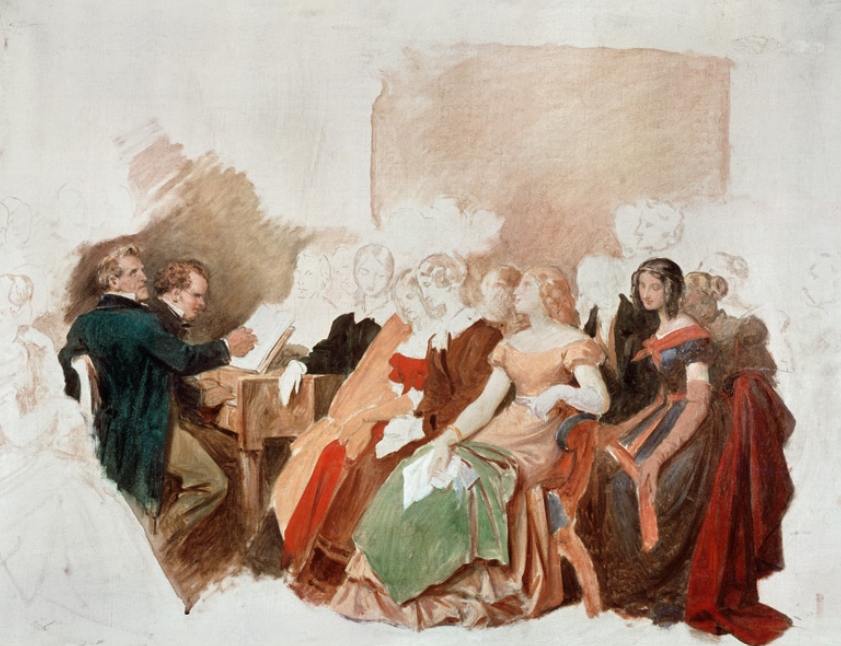
Schubertiade, Unfinished Sketch (Circle of Moritz von Schwind)
This painting is a study left by the painter Moritz von Schwind, a close friend of Schubert and an actual attendee of the Schubertiade. As can be seen from the unfinished outlines of the figures in the background, it is not a completed work but closer to a sketch based on memories of the scene. On the left is a figure sitting at the piano and a singer looking at sheet music next to him; in front of them, elegantly dressed women sit at arm’s length. This scene, where there is no separation between the stage and the audience, captures the typical atmosphere of the ‘Schubertiade’, which continued for over seven years from its first recorded occurrence on January 26, 1821, at the home of Franz von Schober, until at least the last large gathering during Schubert’s lifetime in January 1828 (at the home of Joseph von Spaun).
For Schubert, who possessed neither a court position, nor the doors of an opera house, nor a stable publishing income, such a living room was almost the only stage where his music could actually resonate. In these settings, he premiered his newly finished Lieder and piano pieces; the singer Johann Michael Vogl sang his songs; and the intellectuals of Vienna—poets, painters, and court officials—discussed art throughout the night. Even his masterpiece Winterreise was first unveiled at Schober’s house in the autumn of 1827. The informal seating arrangement and the female-centric audience depicted in the painting show that this gathering was not for mere “viewing” but was predicated on “being together,” serving as a stage that the composer, shut out of grand theaters, had created for himself.
L’essence de la profession de musicien
La raison pour laquelle un musicien écrit un morceau de musique se résume finalement à une chose : quelqu’un doit l’écouter. Une partition n’est rien lorsqu’elle reste dans un tiroir. Elle ne devient musique que lorsqu’elle est jouée et atteint les oreilles d’un public. Ainsi, pour les compositeurs de toute époque, « publier » ou « présenter » leur œuvre était une tâche aussi désespérée que de la créer.
Le problème était que, pour Franz Schubert (1797–1828), ce processus naturel fut bloqué dès le début.
1. La réalité structurelle : l’impossibilité de vivre de la musique
Jusqu’au XVIIIe siècle, il y avait généralement deux façons pour un compositeur de gagner sa vie. La première consistait à obtenir un poste stable à la cour ou à l’église (Maître de chapelle), et la seconde était de devenir le musicien exclusif d’un mécène aristocratique, comme Haydn. Beethoven vécut pendant la période de transition où ces deux modèles s’effondraient, et pourtant, il fut presque le seul exemple de quelqu’un ayant réussi à devenir un « artiste libre » indépendant en combinant les pensions de multiples mécènes aristocratiques, de grands concerts publics et les revenus de publication.
Schubert n’a pu emprunter aucune de ces deux voies.
- Échec à obtenir un poste à la cour : Schubert a postulé pour le poste de vice-maître de chapelle à la chapelle de la cour impériale de Vienne, mais a été rejeté à deux reprises. La seule voie institutionnelle pour un salaire stable lui était fermée.
- Échec à percer sur le marché de l’opéra : Le moyen le plus sûr d’être reconnu comme un « compositeur à succès » à Vienne à l’époque était l’opéra. Schubert a en fait composé plusieurs opéras et Singspiele (par exemple, Alfonso und Estrella, Fierrabras), mais presque aucun n’a été correctement mis en scène de son vivant. L’indifférence des directeurs de théâtre, les problèmes de qualité des livrets et la folie Rossini qui dominait la scène lyrique viennoise se sont combinés pour l’exclure efficacement du genre le plus rentable.
- Contrats d’édition désavantageux : Lorsque Schubert confiait ses pièces aux éditeurs, il devait généralement céder entièrement les droits d’auteur pour une bouchée de pain. Peu importe à quel point la pièce se vendait bien, aucun profit supplémentaire ne lui revenait. De plus, à ses débuts, lorsqu’il était pratiquement inconnu, il était même difficile de trouver un éditeur prêt à accepter son travail.
- Absence de grands concerts publics : Pour présenter au public des œuvres instrumentales à grande échelle comme des symphonies ou des quatuors à cordes, des concerts publics étaient nécessaires. Cependant, l’organisation de tels événements exigeait un capital initial important pour la location de la salle et les frais d’orchestre. En tant que compositeur inconnu, Schubert n’avait ni le capital ni les promoteurs pour organiser de telles scènes. En fait, la plupart des symphonies de Schubert (y compris la 9e, « La Grande ») n’ont jamais été jouées publiquement de son vivant.
En résumé, ce à quoi Schubert a été confronté n’était pas un « manque de talent » mais « l’absence d’un marché en soi ». Les voies pour présenter sa musique au public — cours, opéras, contrats d’édition rentables et grandes scènes publiques — ne lui étaient pas accessibles dès le départ.
2. Les mesures qu’il a prises malgré tout
Ce qui est important ici, c’est que Schubert n’a pas cessé de composer ni ne s’est isolé face à cette réalité. Au lieu de s’en remettre aux chemins que le système refusait de lui ouvrir, il a obstinément tracé des chemins qu’il pouvait ouvrir lui-même.
① L’auto-édition par des amis — Les origines de la Schubertiade
En 1821, des amis se sont mobilisés pour un Schubert encore inconnu. Alors qu’aucun éditeur n’était prêt à prendre le risque, les connaissances de Schubert ont organisé un système de souscription pour publier à compte d’auteur un recueil de ses œuvres, incluant son Lied Erlkönig (Le Roi des aulnes). Lorsque le marché a refusé de l’accepter, les personnes qui tenaient à lui ont effectivement créé un « marché » pour lui.
② L’utilisation des salons comme scènes alternatives
Les grands théâtres et opéras lui étant fermés, Schubert s’est tourné vers des espaces où sa musique pouvait réellement être entendue. Ce fut la « Schubertiade ». Lors de ces rassemblements privés tenus dans les salons d’amis fortunés ou de mécènes, Schubert créait sur place ses Lieder et pièces pour piano fraîchement achevés. Le chanteur Michael Vogl interprétait ses chansons, et les intellectuels de Vienne — poètes, peintres, fonctionnaires — se réunissaient pour discuter de musique et d’art toute la nuit. Il ne s’agissait pas d’un simple rassemblement social, mais d’une « scène de présentation » qu’un compositeur, ne pouvant s’offrir une grande scène, avait créée pour lui-même.
③ Se concentrer sur les genres adaptés aux salons et aux foyers
Plutôt que de s’accrocher uniquement aux grands opéras ou symphonies, qui manquaient de demande populaire, Schubert s’est concentré sur les genres qui étaient réellement consommés dans les foyers bourgeois de Vienne à l’époque — le Lied allemand et les duos pour piano (à quatre mains) — les produisant en grande quantité et avec une qualité exceptionnelle. Parce que ces pièces pouvaient être jouées par des amateurs passionnés à la maison, elles ont commencé à fournir une source de revenus d’édition relativement stable dans la dernière partie de sa vie (à partir du milieu des années 1820). Il a compris le format que le marché désirait et y a imposé sa musique.
④ Le coup de poker final, 26 mars 1828
Huit mois avant sa mort, Schubert a organisé son premier et dernier grand concert public payant, composé entièrement de ses propres œuvres, dans la salle de la Gesellschaft der Musikfreunde à Vienne. Réalisé avec l’aide de ses amis, ce concert fut un succès commercial et lui rapporta un revenu important. Par coïncidence, cependant, Paganini a commencé à se produire à Vienne quelques jours plus tard, monopolisant l’attention de la ville, et le concert de Schubert est passé sans recevoir beaucoup d’attention de la part de la presse de l’époque.
3. Là où réside la musique
En fin de compte, pour Schubert, « là où réside la musique » n’était pas l’endroit où il souhaitait qu’elle soit, mais là où il pouvait l’avoir. La cour, l’opéra et les contrats d’édition stables n’existaient pas pour lui. Au lieu de cela, il a relié tous ces petits espaces — le salon d’un ami, une liste de souscripteurs, la partition sur le piano d’un musicien amateur, et la seule grande scène qui lui a été accordée à la fin de sa vie — pour offrir sa musique au monde.
Ce qu’il a laissé derrière lui n’est pas le récit d’un succès glamour, mais la pratique tenace d’un homme qui a créé un chemin là où il n’y en avait pas. Et c’est précisément grâce à cette ténacité que, près de 200 ans après sa mort, ses Lieder et sa musique de chambre sont toujours joués, et continuent d’atteindre les oreilles de quelqu’un aujourd’hui.
Remarque : Parmi les peintures représentant une Schubertiade, la plus célèbre est l’œuvre du peintre Moritz von Schwind (1804–1871). Puisque Schwind était un ami proche de Schubert et un participant réel à la Schubertiade, ses peintures sont précieuses non seulement comme œuvres d’imagination, mais aussi comme témoignages documentaires de l’atmosphère de l’époque.
Schubertiade, croquis inachevé (Entourage de Moritz von Schwind)
Cette peinture est une étude laissée par le peintre Moritz von Schwind, un ami proche de Schubert et participant réel à la Schubertiade. Comme on peut le voir aux contours inachevés des personnages à l’arrière-plan, il ne s’agit pas d’une œuvre achevée mais plutôt d’un croquis basé sur les souvenirs de la scène. À gauche se trouve un personnage assis au piano et un chanteur regardant une partition à côté de lui ; devant eux, des femmes élégamment vêtues sont assises à portée de main. Cette scène, où il n’y a pas de séparation entre la scène et le public, capture l’atmosphère typique de la « Schubertiade », qui s’est poursuivie pendant plus de sept ans depuis sa première occurrence enregistrée le 26 janvier 1821 au domicile de Franz von Schober, jusqu’au moins le dernier grand rassemblement du vivant de Schubert en janvier 1828 (au domicile de Joseph von Spaun).
Pour Schubert, qui ne possédait ni poste à la cour, ni accès aux portes d’un opéra, ni revenus stables de l’édition, un tel salon était presque la seule scène où sa musique pouvait réellement résonner. Dans ces cadres, il créait sur place ses Lieder et pièces pour piano fraîchement achevés ; le chanteur Johann Michael Vogl interprétait ses chansons ; et les intellectuels de Vienne — poètes, peintres et fonctionnaires de la cour — discutaient d’art tout au long de la nuit. Même son chef-d’œuvre Le Voyage d’hiver (Winterreise) a été dévoilé pour la première fois chez Schober à l’automne 1827. La disposition informelle des sièges et le public à prédominance féminine représentés dans la peinture montrent que ce rassemblement n’était pas destiné à être un simple « spectacle » mais reposait sur le fait d’« être ensemble », servant de scène que le compositeur, exclu des grands théâtres, avait créée pour lui-même.
음악가라는 직업의 본질
음악가가 곡을 쓰는 이유는 결국 하나다. 누군가 그것을 들어야 한다. 악보는 서랍 속에 있을 때 아무것도 아니다. 연주되고, 청중의 귀에 닿고, 그 순간 비로소 음악이 된다. 그래서 어느 시대든 작곡가에게 ‘발표’는 창작만큼이나 절박한 과제였다.
문제는 프란츠 슈베르트(1797–1828)에게는 이 당연한 과정이 처음부터 막혀 있었다는 점이다.
1. 음악으로 돈을 벌 수 없었던 구조적 현실
18세기까지 작곡가가 생계를 해결하는 길은 대체로 두 가지였다. 궁정이나 교회에 소속된 안정적 직책(카펠마이스터)을 얻거나, 하이든처럼 귀족 후원자의 전속 음악가가 되는 것이다. 베토벤은 이 두 모델이 무너지던 과도기에 살면서도, 귀족 후원자 여럿의 연금과 대형 공개 연주회, 출판 수입을 결합해 ‘자유 예술가’로 자립하는 데 성공한 거의 유일한 사례였다.
슈베르트는 이 어느 길도 걷지 못했다.
- 궁정 직책 실패: 슈베르트는 빈 궁정 예배당의 부지휘자 자리에 지원했지만 두 차례 모두 탈락했다. 안정적인 급여를 받을 유일한 제도적 통로가 막힌 것이다.
- 오페라 시장 진입 실패: 당대 빈에서 ‘성공한 작곡가’로 인정받는 가장 확실한 길은 오페라였다. 슈베르트는 실제로 여러 편의 오페라와 징슈필을 작곡했지만(《알폰소와 에스트렐라》, 《피에라브라스》 등), 생전에 무대에 제대로 올라간 작품은 거의 없었다. 극장 감독들의 외면, 대본의 완성도 문제, 빈 오페라계를 장악한 로시니 열풍 등이 겹치며 그가 가장 수익성이 높은 장르에서 사실상 배제되었다.
- 출판 계약의 불리함: 슈베르트가 곡을 출판사에 넘길 때는 대개 저작권 자체를 헐값에 완전히 양도하는 방식이었다. 곡이 아무리 잘 팔려도 추가 수익이 그에게 돌아오지 않았다. 게다가 무명에 가까웠던 초기에는 이마저도 받아줄 출판사를 찾기 어려웠다.
- 대형 공개 연주회의 부재: 교향곡이나 현악4중주 같은 본격적인 기악곡을 대중 앞에 선보이려면 공개 연주회가 필요했다. 그러나 이런 무대를 열려면 홀 대관료, 오케스트라 섭외비 등 상당한 초기 자본이 필요했고, 무명 작곡가에게는 그런 자본도, 그런 무대를 주선해줄 흥행업자도 없었다. 실제로 슈베르트의 교향곡 대부분(9번 ‘그레이트’를 포함해)은 그가 살아있는 동안 단 한 번도 공개 연주되지 못했다.
정리하면, 슈베르트가 마주한 것은 ‘재능 부족’이 아니라 ‘시장 자체의 부재’였다. 그의 음악을 대중에게 들려줄 통로 — 궁정도, 오페라 극장도, 수익성 있는 출판 계약도, 대형 공개 무대도 — 가 애초에 마련되어 있지 않았다.
2. 그럼에도 그가 멈추지 않고 취한 행동들
여기서 중요한 것은 슈베르트가 이 현실 앞에서 작곡을 그만두거나 은둔하지 않았다는 사실이다. 그는 제도가 열어주지 않은 길 대신, 자신이 열 수 있는 길을 끈질기게 만들어냈다.
① 친구들을 통한 자비 출판 — 슈베르티아데의 기원
1821년, 무명이었던 슈베르트를 위해 친구들이 나섰다. 어느 출판사도 위험을 감수하려 하지 않자, 슈베르트의 지인들이 직접 예약 구독(subscription) 방식을 조직해 그의 가곡 〈마왕(Erlkönig)〉을 포함한 작품집을 자비로 출판시켰다. 이는 시장이 그를 받아주지 않자, 그를 아끼는 사람들이 사실상 대신 ‘시장’을 만들어준 사건이었다.
② 살롱을 대안 무대로 삼다
대극장과 오페라하우스가 닫혀 있는 상황에서, 슈베르트는 자신의 음악이 실제로 울릴 수 있는 공간을 찾아 옮겨갔다. 그것이 ‘슈베르티아데(Schubertiade)’다. 부유한 친구나 후원자의 거실에서 열린 이 사적 모임에서, 슈베르트는 갓 완성한 가곡과 피아노곡을 그 자리에서 초연했다. 성악가 미하엘 포글이 그의 가곡을 노래하고, 시인·화가·공무원 등 빈의 지식인들이 모여 밤새 음악과 예술을 논했다. 이는 단순한 사교 모임이 아니라, 대형 무대를 가질 수 없는 작곡가가 스스로 마련한 ‘발표의 장’이었다.
③ 살롱과 가정에 맞는 장르에 집중
슈베르트는 대중적 수요가 없는 대형 오페라나 교향곡에만 매달리지 않고, 당시 빈의 부르주아 가정에서 실제로 소비되던 장르 — 독일 가곡(Lied)과 네 손을 위한 피아노 연탄곡 — 을 대량으로, 그리고 대단히 높은 완성도로 써냈다. 이 곡들은 아마추어 애호가들이 집에서 직접 연주할 수 있었기에, 그의 생애 후반부(1820년대 중반 이후)에는 실제로 어느 정도 안정적인 출판 수입원이 되기 시작했다. 시장이 원하는 형태를 파악하고 그 안에서 자신의 음악을 관철시킨 것이다.
④ 마지막 승부수, 1828년 3월 26일
세상을 떠나기 8개월 전, 슈베르트는 생애 처음이자 마지막으로 자신의 작품만으로 구성된 대규모 공개 유료 연주회를 빈 악우협회 홀에서 열었다. 친구들의 도움으로 성사된 이 무대는 상업적으로 성공을 거두어 그에게 상당한 수입을 안겼다. 다만 공교롭게도 며칠 뒤부터 파가니니가 빈에서 연주를 시작하며 도시의 관심을 독차지했고, 슈베르트의 이 무대는 당대 언론의 큰 주목을 받지 못한 채 지나갔다.
3. 음악이 머무는 곳
결국 슈베르트에게 ‘음악이 머무는 곳’은 그가 원했던 곳이 아니라, 그가 가질 수 있었던 곳이었다. 궁정도, 오페라 극장도, 안정적인 출판 계약도 그를 위해 존재하지 않았다. 대신 그는 친구의 거실, 예약 구독자 명단, 아마추어 연주자의 피아노 위 악보, 그리고 생의 마지막에 단 한 번 허락된 큰 무대 — 이 모든 작은 공간들을 이어 붙여 자신의 음악을 세상에 내놓았다.
그가 남긴 것은 화려한 성공의 기록이 아니라, 통로가 없을 때 통로를 만들어낸 한 사람의 끈질긴 실천이다. 그리고 바로 그 끈질김 덕분에, 그가 세상을 떠난 지 200년 가까이 지난 지금도 그의 가곡과 실내악은 여전히 연주되고, 여전히 누군가의 귀에 닿고 있다.
참고: 슈베르티아데를 그린 그림 중 가장 유명한 것은 화가 모리츠 폰 슈빈트(Moritz von Schwind, 1804–1871)의 작품입니다. 슈빈트는 슈베르트의 절친한 친구이자 슈베르티아데의 실제 참석자였기 때문에, 그의 그림들은 단순한 상상화가 아니라 당대 분위기를 증언하는 자료로도 평가받습니다.
슈베르티아데, 미완성 스케치 (모리츠 폰 슈빈트 계열)
이 그림은 슈베르트의 절친한 친구이자 슈베르티아데의 실제 참석자였던 화가 모리츠 폰 슈빈트가 남긴 습작으로, 배경 인물들의 미완성 윤곽선에서 알 수 있듯 완성작이 아니라 현장의 기억을 바탕으로 한 스케치에 가깝다. 왼쪽에는 피아노 앞에 앉은 인물과 그 옆에서 악보를 보며 노래하는 성악가가 있고, 그 앞으로 화려하게 차려입은 여성들이 팔이 닿을 듯한 거리에 둘러앉아 있다. 무대와 객석의 구분이 없는 이 장면은, 1821년 1월 26일 프란츠 폰 쇼버의 자택에서 처음 기록된 이래 최소 1828년 1월 슈베르트 생전 마지막 대규모 모임(요제프 폰 슈파운 자택)까지 7년 넘게 이어진 ‘슈베르티아데’의 전형적 풍경을 담고 있다.
궁정 직책도, 오페라 극장의 문도, 안정적인 출판 수입도 갖지 못했던 슈베르트에게 이런 거실은 자신의 음악이 실제로 울릴 수 있는 거의 유일한 무대였다. 이 자리에서 그는 갓 완성한 가곡과 피아노곡을 그 자리에서 초연했고, 성악가 요한 미하엘 포글이 그의 가곡을 노래했으며, 시인·화가·궁정 관리 등 빈의 지식인들이 밤새 예술을 논했다. 심지어 그의 대표작 《겨울 나그네》조차 1827년 가을 쇼버의 집에서 처음 공개되었다. 그림 속 격식 없는 앉음새와 여성 중심의 청중은 이 모임이 ‘관람’이 아니라 ‘함께 있음’을 전제로 한 자리였음을, 그리고 대극장이 닫혀 있던 작곡가가 스스로 만들어낸 발표의 장이었음을 보여준다.