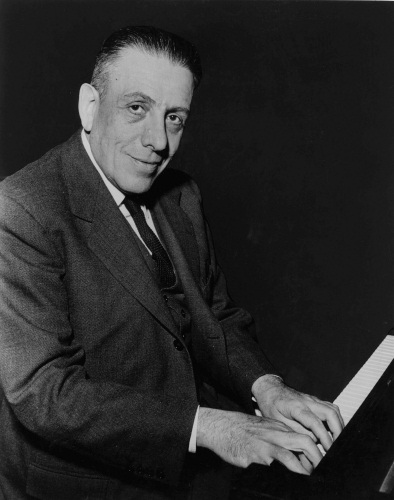
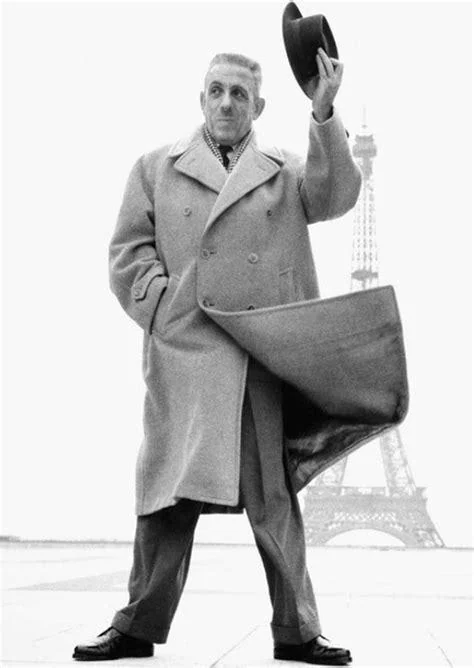
Description
Francis Poulenc – “Les chemins de l’amour,” FP 106 (1940)
“Les chemins de l’amour” (“The Paths of Love”) is one of Francis Poulenc’s most lyrical and evocative mélodies, composed in 1940 to a poem by Jean Anouilh. The work originated as a valse chantée in Anouilh’s play Léocadia, where it was conceived for the stage and associated with the singer and actress Yvonne Printemps.
The song reflects upon the paths once walked with a loved one and the memories that remain after love has passed. Rather than presenting love as dramatic tragedy, Poulenc creates a world in which beauty, memory, longing, and loss coexist within an elegant waltz.
The voice is at the center of the original conception. Poulenc writes the vocal melody not simply as an abstract melodic line, but as a musical expression of French language. The words, their natural accents, their syllabic rhythm, and their emotional inflections are closely integrated into the melody.
The singer should therefore not approach the piece as though it were a conventional operatic aria. The vocal line often has the character of speech transformed into music. A phrase may gently advance, hesitate, yield, or accelerate according to the meaning and emotional direction of the words. The listener should feel that the singer is remembering and speaking through melody rather than merely displaying vocal technique.
This relationship between language and music is one of the defining characteristics of Poulenc’s chanson style. The French text remains an essential part of the musical expression. The melody gains much of its meaning from the natural inflection of the language, while the piano creates the harmonic and rhythmic environment in which the words can unfold.
For a singer, therefore, the essential task is not simply to produce a beautiful tone. The singer must preserve the clarity of the French text while allowing the musical phrase to breathe naturally. Consonants, vowels, syllabic emphasis, legato, and subtle changes of intensity must work together so that the listener can hear both the meaning of the words and the emotional movement behind them.
The characteristic waltz rhythm gives the song an immediately graceful and attractive surface. Beneath this apparent lightness, however, lies a profound sense of remembrance. The music seems to look backward toward a past that can no longer be recovered, allowing the listener to experience both the beauty of the memory and the sadness of its disappearance.
The piano plays a particularly important role in establishing this atmosphere. Rather than functioning merely as harmonic support, it creates the world of memory in which the voice exists. Its waltz rhythm provides continuity and movement, while its harmonic changes suggest the changing emotional perspective of someone remembering the past.
The relationship between voice and piano is therefore more than melody accompanied by harmony. The voice tells the memory, while the piano creates the space and movement in which that memory unfolds. At times the piano seems to carry the singer forward; at other moments it creates a moment of suspension in which the words can linger.
For a violin arrangement, the violin takes over the role originally given to the voice. This does not mean that the violin should simply reproduce the pitches of the vocal melody. It should preserve the expressive function of the singing voice—its phrasing, breathing, speech-like inflection, and emotional restraint.
The violin must therefore retain something of the natural inflection of the French voice. The rise and fall of the phrase, the gentle hesitation between words, the direction of the melodic line, and the feeling of an unspoken thought should remain audible even when the words themselves are no longer being sung.
The absence of actual words makes this especially challenging. A singer can communicate meaning through vowels, consonants, and verbal accents; the violin must communicate the same underlying structure through bow speed, articulation, vibrato, dynamics, timing, and tone color.
For the pianist, one of the greatest challenges is maintaining the characteristic waltz movement without making the rhythm mechanically regular. The music requires flexibility within continuity. The underlying pulse must remain perceptible, but the phrasing should breathe naturally through subtle changes of timing, articulation, dynamics, and harmonic emphasis.
This is particularly important in passages marked by indications such as librement, céder, au mouvement, Più mosso, Animato, and molto ritard. These markings should not be understood simply as instructions to change the metronome speed. They describe changes in the direction and energy of musical time.
The performer must therefore distinguish between mechanical tempo and expressive musical time. A slight yielding of tempo can represent hesitation, recollection, or emotional suspension, while the return au mouvement restores the forward flow. Later acceleration can make the remembered world suddenly vivid and alive, while the final ritardando allows that memory gradually to recede.
For a violin arrangement, this flexibility becomes especially significant. The violinist and pianist must anticipate one another rather than simply react after hearing a tempo change. Their coordination depends on shared phrasing, breathing points, harmonic awareness, and an intuitive understanding of where the musical line is moving.
The violin should therefore sound as though it is remembering rather than merely playing a melody. Its tone should remain lyrical and expressive, but the emotion should be controlled rather than exaggerated. The goal is not to imitate an operatic aria, but to preserve the intimate, speech-like quality of Poulenc’s chanson.
The pianist must also avoid excessive weight. The accompaniment should preserve the lightness and transparency of the waltz while giving sufficient harmonic depth to support the melody. Too much rhythmic emphasis can make the music sound like an ordinary salon waltz; too much sentimentality can obscure its refined French character.
The central expressive principle of the work can therefore be understood as elegant remembrance. The music does not attempt to remain permanently inside the past. Instead, it allows the singer—or, in this arrangement, the violinist—to enter the world of a remembered love, experience its beauty again, and then gradually return to the present.
In this sense, Les chemins de l’amour is both a song of love and a song about memory itself. The paths of love exist now as recollection: beautiful because they were lived, and poignant because they cannot be lived again in exactly the same way.
For the singer, the words make this memory explicit. For the violinist, the melody must make the same memory audible without words. The violin therefore becomes a wordless voice, carrying the emotional and rhetorical character of the original chanson.
For the violinist and pianist, the goal is not simply to reproduce the notes and rhythms accurately, but to recreate the changing movement of memory—its moments of clarity, hesitation, warmth, acceleration, and disappearance.
“Les chemins de l’amour” is ultimately a refined meditation on love, memory, time, longing, and acceptance, expressed through the graceful form of a French waltz. Poulenc transforms the apparently simple language of the chanson into music of remarkable emotional depth, where the voice, piano, and waltz rhythm work together to create a world in which elegance and melancholy exist together without contradiction.
High-Quality Piano Accompaniment
Suitable for Singers
Suitable for Violinists
Suitable for Instrumentalists
Ideal for Practice, Rehearsal, Recording, and Performance Preparation



Reviews
There are no reviews yet.